
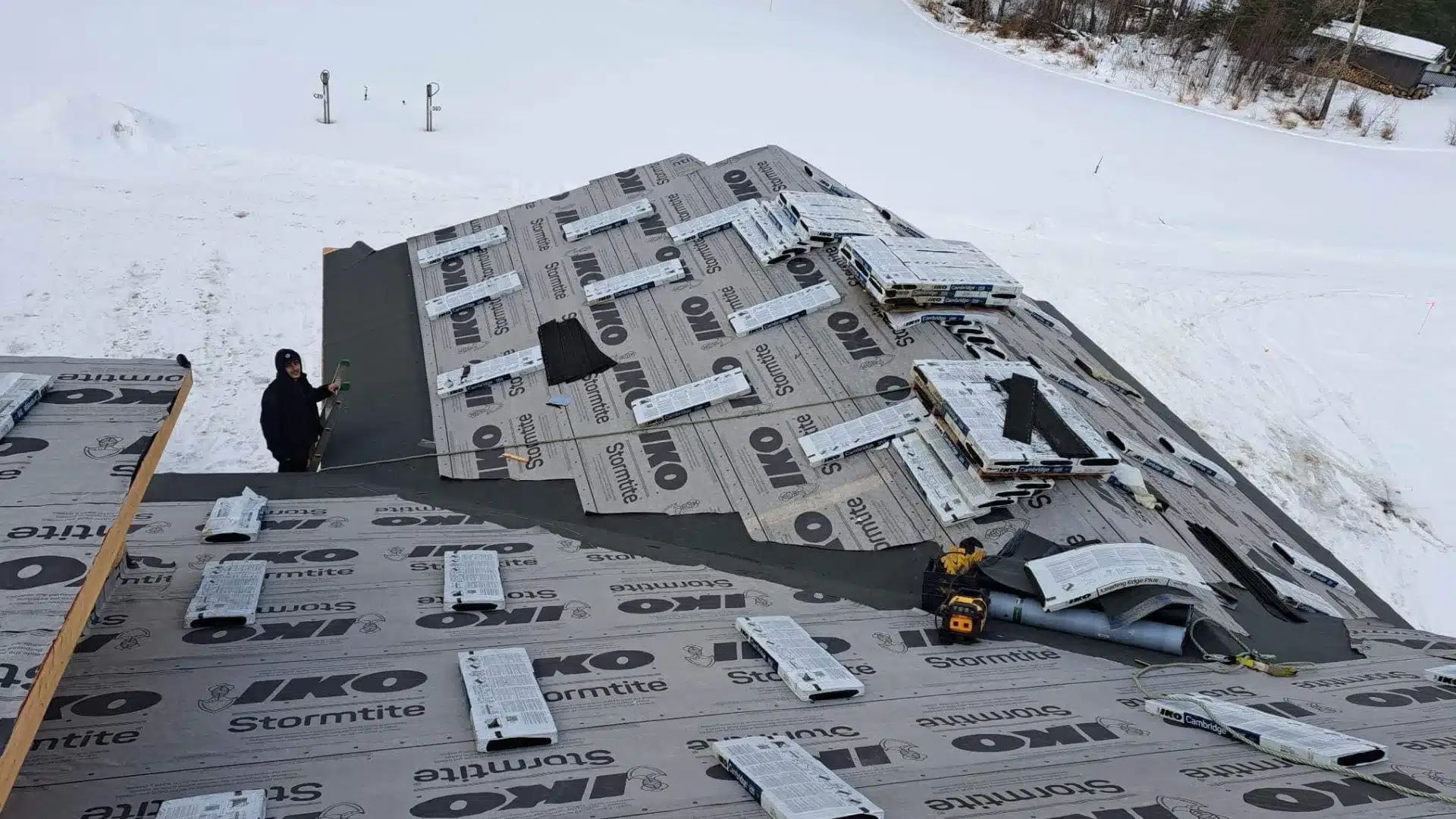
Ice and water shield membrane (ice guard): what is it for on a roof in Quebec?
When you think of a roof, you mostly picture the shingles. But beneath those shingles lies a discreet layer that plays a major role in our climate: the ice and water shield, more commonly called the ice barrier. It's what protects the most vulnerable areas of your roof against water and ice.
In Quebec, between heavy snow, thaws, and ice dams, this membrane isn't a luxury — it's essential protection. In homes across the West Island and Vaudreuil-Soulanges, it often makes the difference between a peaceful winter and a costly leak. Here's why.
Why is an ice barrier membrane essential on a roof in Quebec?
Our climate is one of the toughest on a roof. Snow accumulates, partially melts during thaws, then refreezes when temperatures drop again. This cycle creates the infamous ice dams, which push water where it shouldn't go.
A self-adhering membrane installed at the eaves and other strategic points blocks that water before it reaches the wood. It's an extra layer of’waterproofing , designed specifically for winter conditions.
Many homes in the West Island and Vaudreuil-Soulanges were built between the 1960s and 1980s, at a time when these membranes weren't the standard. It's often on these roofs that you find the most frequent leaks, due to a lack of proper protection at critical points.
And no, a simple underlayment isn't enough. A traditional underlayment protects the general roof surface, but it doesn't seal around nails and can't withstand water backed up by an ice dam. The ice barrier, on the other hand, is made for exactly that.
How do ice dams cause leaks?
The mechanism is simple. Heat escaping from the attic melts the snow on the upper part of the roof. The water runs down, reaches the colder edge, refreezes there, and forms a dam. The water behind it gets trapped and looks for a way through — often by working its way up under the asphalt shingles .
Once under the shingles, that water seeps into the roof cavity. It soaks the insulation, promotes’moisture and mold, and can damage the decking (the plywood beneath the shingles). It's exactly this backed-up water that the ice barrier is designed to stop.
Why is freeze-thaw a major challenge in the West Island?
Our region combines every risk factor: plenty of snowfall, freezing rain, the winds that redistribute snow unevenly, and above all, many temperature cycles around the freezing point.
These freeze-thaw cycles — often 60 to 100 per year, sometimes more in southern Quebec — put constant stress on your roof. Every thaw followed by a freeze is an opportunity for an ice dam to form. It's this local climate reality that makes the ice barrier so important here.
Request a free inspection to check whether your roof is properly protected in the high-risk zones. We'll inspect the membrane, flashings, and ventilation — at no cost.
What exactly is an ice barrier membrane?
The ice barrier is a self-adhering bituminous membrane, typically made with modified rubber. It bonds directly to the roof deck, under the shingles, and forms a fully watertight barrier.
What sets it apart is its ability to seal around nails. When a shingle nail pierces it, the material closes back around the shaft — a property known as self-sealing. That's what keeps water out even at the fastening points, where a regular underlayment would let moisture through.
Unlike a traditional underlayment (often felt or synthetic), which isn't adhered and mainly serves as temporary protection and separation, the ice barrier provides a true permanent waterproofing membrane Both have their place on a roof, but they don't play the same role.
Where is ice and water shield installed?
We don’t cover the entire roof with ice and water shield — we focus it where the risk of infiltration is highest. The first place is the roof edges (eaves), where ice dams form.
Next come the valleys (the recessed junctions between two slopes), where water and snow collect, as well as the perimeter of chimneys, the skylights and all roof penetrations (plumbing vents, exhaust fans).
In short, we protect all high-risk zones : everywhere water accumulates, changes direction, or passes through the roof. These are precisely the spots where leaks most often begin.
Why are valleys so vulnerable?
A valley acts like a channel: it concentrates water from two slopes into a single point. In winter, snow builds up more there and melts more slowly. Without a waterproofing reinforced by ice and water shield, this concentration point becomes one of the first places where water seeps in.
Why do roof edges need protection?
Roof edges are cold because they extend beyond the heated wall of the house. That’s where’ice buildup forms and where’backed-up water tries to work its way up under the shingles. An ice and water shield at the edge protects the decking and keeps that water from reaching the interior.
Ice and water shield vs. standard underlayment: what’s the difference?
People often confuse the two, but their roles are quite distinct. Standard underlayment covers the general roof surface beneath the shingles; ice and water shield seals critical zones against water and ice. On a well-built roof in Quebec, both are typically used, each in its proper place.
Ice and water shield costs more per square foot, but it’s only installed where needed. The more economical underlayment covers the rest. So it’s not «one or the other» — it’s about putting the right material in the right spot.
Here’s how the two compare:
| installation quality | Ice and water shield (self-adhering membrane) | Standard underlayment |
| Waterproofing | Complete, seals around nails | Partial, not adhered |
| Water resistance | High, designed for backed-up water | Temporary surface protection |
| Protection against ice dams | Yes, that’s its main role | No |
| Cost | Higher per square foot | More economical |
| Durability | Permanent, integrated into the roof | Mainly useful during and after installation |
| Where to use it | Eaves, valleys, chimneys, penetrations | Rest of the roof surface |
The most common myths
«Ice and water shield is just for old roofs.» False. A new roof that isn't properly protected at critical points can leak as early as the first winter. Ice and water shield is about best practices, not age.
«Clean gutters are enough.» Gutters help with drainage, but they don't stop water backing up behind an ice dam. It's the ice and water shield that protects under the shingles, not the gutter.
«It's an unnecessary expense» and «all membranes are the same» are two other common beliefs. In our climate, skipping the ice and water shield means saving a few dollars today to risk a costly leak later. And no, a regular synthetic underlayment doesn't offer the same watertight protection as a self-adhering membrane.
Talk to a roofing expert on our team to find out which protection is right for your home. We'll explain it clearly, without jargon.
Is ice and water shield mandatory on a roof in Quebec?
Eave protection is required by best building practices and by the Quebec Construction Code for sloped roofs covered with shingles. In practical terms, a watertight membrane at the eaves is part of what's expected for a well-built residential roof.
Add to that the manufacturer recommendations for shingles: many require ice and water shield at critical zones to honor their warranties. Skipping this step can therefore affect both the compliance of the work and your warranty coverage.
That's where a licensed RBQ contractor makes the difference. They know the applicable requirements and install the membrane to code. Since application details can vary depending on the situation, the best approach is to have your roof validated by an RBQ professional rather than relying on generalities.
Why Groupe Deluxe systematically installs ice and water shield during a complete roof replacement
For us, ice and water shield is part of the standard on every roof replacement. It's not an option we offer as an extra — it's a matter of compliance, in quality and prevention.
We'd rather do things right the first time. Installing the membrane in the right places from the start means giving our clients true peace of mind for the next 20 years, instead of coming back to fix a preventable leak.
The advantage of a 100% in-house team
Because all our work is done by our own crew, no subcontracting, we maintain quality control on every detail — including membrane installation. Direct communication and adherence to standards from start to finish: that's what guarantees the ice and water shield is installed properly, not rushed to save time.
What are the long-term benefits of an ice and water shield membrane?
Investing in a good ice and water shield means solving a problem before it happens. The problem — ice dams and backed-up water — leads to costly consequences : leaks, soaked insulation, mold, and damaged decking.
The solution is a membrane properly installed in at-risk areas, by a team that knows the local climate. The benefit, is tangible: less’leaks, better lifespan of the roof, a attic protection and mold prevention.
In some cases, a Roof repair may be needed before a leak causes more significant damage.
Add to that future savings — every leak prevented is one less major repair — and better property value. A well-protected roof reassures potential buyers and avoids nasty surprises at the pre-purchase inspection.
On the budget side, the ice-and-water shield typically represents 5 to 10% of the cost of a re-roofing (a reasonable estimate — it varies depending on the surface area to protect). It's a small slice of the project for protection that prevents far costlier repairs. Combined with good insulation (around R-50) and effective attic ventilation, it forms the foundation of a roof that stands up to Quebec winters without faltering.
When should the ice-and-water shield be replaced?
The ice-and-water shield is designed to last as long as the roof itself. So it isn't replaced separately: it's renewed during a full replacement roof replacement.
That's also why it's hard to properly ’add« an ice-and-water shield to an existing roof without redoing certain sections — the membrane has to be laid directly on the roof deck, under the shingles. A professional inspection lets you check whether your current roof is protected and plan the replacement at the right time.
Get a free estimate for your roof replacement. We assess your real needs and clearly explain what's required.
How Groupe Deluxe protects homes in the West Island and Vaudreuil-Soulanges
Based in Pincourt, we've been working on roofs in the area for over 15 years. We know the homes, we know the winters, and we know where leaks start.
Our approach always starts with a complete inspection and an honest assessment. We take the time to’explain your real needs, without padding the bill with unnecessary work.
On the execution side, we use quality materials, installed by our in-house team, with the homeowner involved in the decisions. We set a realistic timeline and we stick to it.
All with transparent communication from start to finish. Whether you're in Pincourt, Vaudreuil-Dorion, L'Île-Perrot, Pointe-Claire, Kirkland, or Dollard-des-Ormeaux, you always know where your project stands.
Our process
- Free inspection of your roof and attic.
- Complete assessment of the actual condition and at-risk areas.
- Explanation of recommendations, with photos to back them up.
- Transparent estimate, with no hidden costs.
- Code-compliant installation , by our in-house team.
- Final inspection to validate the quality of the work.
Why choose Groupe Deluxe?
- 15+ years of experience in roofing and residential renovation.
- RBQ licence (5849-4311-01) and work that meets code.
- 100% in-house team, no subcontracting.
- Local reputation in the West Island and Vaudreuil-Soulanges.
- Lasting quality and on-time project completion.
Book your free inspection starting today. Winter protection, local expertise, in-house team, and free estimate.
Frequently asked questions
What exactly does an ice-and-water shield do?
It's a self-adhesive membrane installed under the shingles in high-risk areas that blocks water backed up by ice dams and prevents leaks. It seals around nails, which a regular underlayment doesn't do.
Is it required on all roofs?
Protection for roof edges is required by the Quebec Construction Code for shingle roofs, and many manufacturers require it for their warranties. Since installation varies by situation, a licensed RBQ contractor can confirm what applies to your home.
How is it different from underlayment?
Underlayment protects the general roof surface and isn't adhesive. Ice-and-water shield is a self-adhering, waterproof membrane designed for critical zones (eaves, valleys, penetrations). Both are typically used, each in its proper place.
Where is this membrane installed?
On roof eaves (overhangs), in valleys, and around chimneys, skylights, and penetrations. These are the spots where water accumulates, changes direction, or passes through the roof.
Can you replace just the ice-and-water shield?
Not really. The membrane goes directly on the roof deck, under the shingles, so it's replaced during a full re-roofing. It can't be properly added without redoing the affected sections.
Do ice dams damage a new roof?
Yes, if attic ventilation or insulation is inadequate or if critical zones aren't well protected. Shingle age doesn't prevent an ice dam from forming.
Does ice-and-water shield extend shingle lifespan?
Indirectly, yes. By preventing water from seeping in and damaging the deck, it protects the structure beneath the shingles and avoids repairs that shorten a roof's life.
When should you schedule a pre-winter inspection?
Fall is the ideal time, once the trees have shed their leaves and before the first snow. It leaves time to fix weak points before ice sets in.
Request a free roof inspection
Want to know if your roof is well protected against water and ice? We offer a free inspection to homeowners in West Island and Vaudreuil-Soulanges — Pincourt, Vaudreuil-Dorion, L'Île-Perrot, Pointe-Claire, Kirkland, Dollard-des-Ormeaux, Beaconsfield, Dorval, Pierrefonds, Sainte-Anne-de-Bellevue, and surrounding areas.
Winter protection, local expertise, a 100% in-house team, and a free estimate: that's how we protect your home before damage gets costly.
Book your free inspection with Groupe Deluxe — full assessment, photos, honest recommendations, no obligation.
Groupe Deluxe · 13 Av. de la Promenade, Pincourt, QC J7W 9C2 · (514) 238-5071 · groupedeluxe.ca · Licensed contractor RBQ 5849-4311-01