
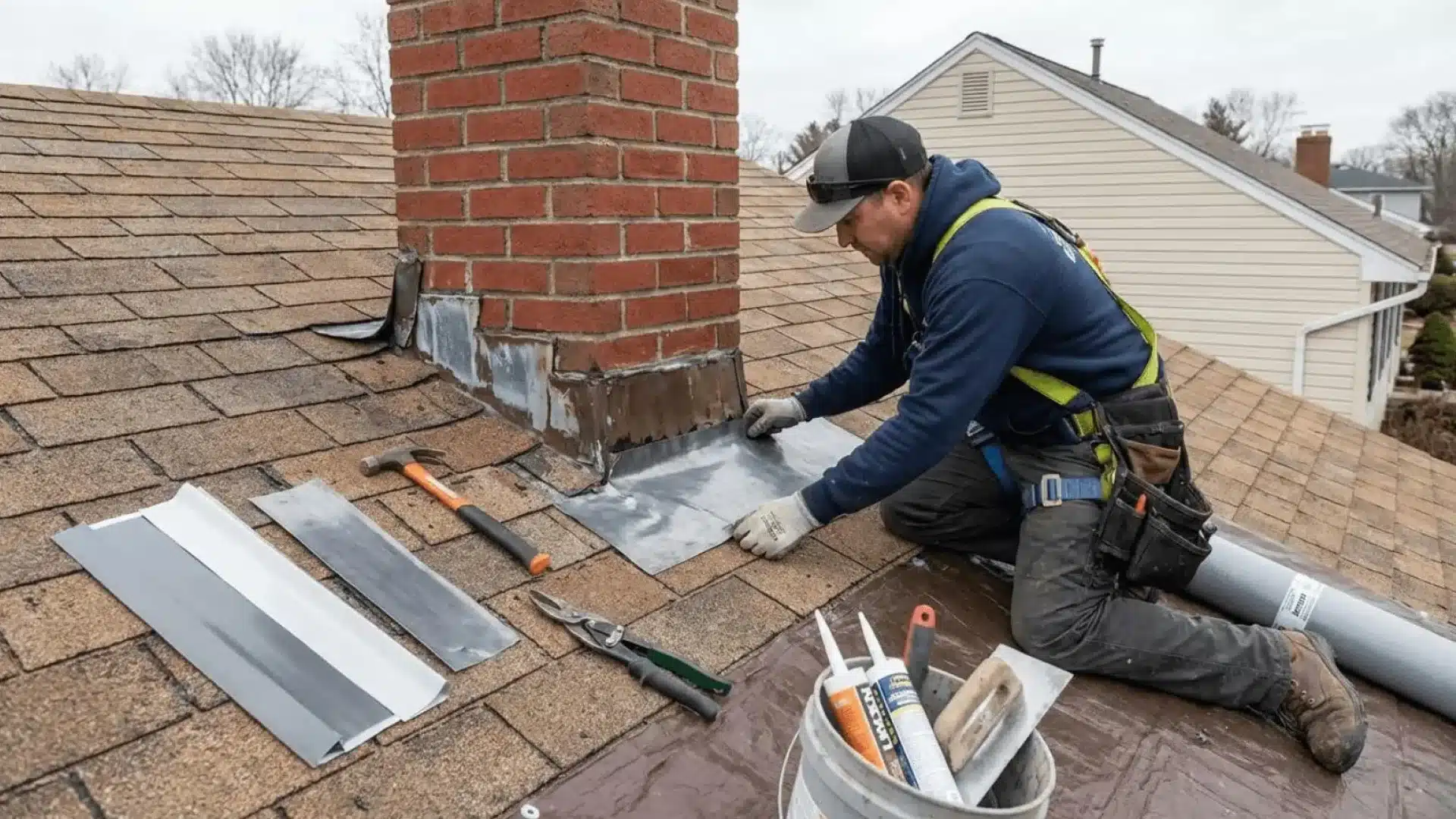
Roof flashing: its role, signs of wear, and when to replace it
When a roof leaks, the shingles often get the blame. But in the vast majority of cases, water gets in somewhere else: through the flashing. These metal pieces ensure watertightness at the roof's junctions — around the chimney, in the valleys, against the walls. Discreet, but essential.
Flashing is literally the number one weak point of a roof. They work in the most exposed areas, and they're almost always the first to fail. Learning to spot worn flashing before a leak appears can save you a lot of damage — and expense.
Why is flashing the number one weak point of a roof?
Flashing is a strip of metal installed at critical junctions of the roof, where two surfaces meet or where an element penetrates the roof. Its job: to direct water outward and keep it from seeping in.
On a’building envelope, shingles cover the large flat surfaces. But as soon as there's an opening or a change in angle — a chimney, a skylight, a valley, a wall —, shingles aren't enough anymore. That's where flashing takes over to ensure’waterproofing.
The problem is that these junctions are also the most stressed areas. Water pools there, snow accumulates, and building movements are more pronounced. That's why most leaks start around openings, not in the middle of slopes.
On many homes in the West Island and Vaudreuil-Soulanges built between the 1960s and 1980s, the flashing is original. After decades of Quebec winters, it often reaches the end of its life long before anyone thinks about it — which is why it's so important to have it inspected.
How water seeps in around chimneys, skylights, and valleys
The’rainwater and the melting snow always find the easiest path. At junctions, if the flashing is worn or poorly installed, they find an opening and get in. In winter, the ice makes everything worse by creating dams that push water back up.
Around a chimney or in a valley, a reverse slope or an open joint is all it takes for water to seep in under pressure. And this gradual infiltration is sneaky: it often starts with a few invisible drops, then worsens season after season until it reaches the ceiling.
Why Quebec's climate accelerates flashing wear
Our freeze-thaw cycles — often 60 to 100 per year, sometimes more in southern Quebec — constantly expand and contract the metal. This repeated expansion and contraction fatigues the joints and loosens the fasteners over time.
Add to that the snow that accumulates, the wind that lifts, the’moisture persistent moisture that promotes rust, and the summer UV rays that dry out the sealant. Each of these factors wears down flashing; together, they wear it down fast. That's why flashing that might last 30 years in a mild climate often ages more quickly here.
Request a free roof inspection. We inspect the condition of flashing around the chimney, valleys, and penetrations — at no charge.
What is flashing and what types are found on a roof?
The word «flashing» actually covers several different pieces, each adapted to a specific junction. It's sometimes called sheet metal work to refer to all these metal elements.
These include chimney flashing (with their counter-flashing embedded in the masonry), the valley flashing in the roof valleys, the wall-to-roof flashing where the roof meets a vertical wall, and the flashing around vents, the dormers and mechanical penetrations.
As for materials, the most common are’galvanized steel (economical but more prone to rust),’aluminum (lightweight and corrosion-resistant) and, more rarely in residential, copper (durable and attractive, but costly). The choice directly affects the lifespan of the flashing.
Areas where flashing is essential
Some parts of a roof simply cannot be watertight without flashing. The chimney chimney is at the top of the list: it penetrates the roof and creates a full perimeter that needs protection.
Next come the and ceiling. (where a shed roof meets the house), the valleys valleys (where two slopes intersect), and all openings: skylights, skylights, and mechanical penetrations like plumbing vents and ventilation.
exhaust vents. Each of these areas is a transition point where water changes direction or hits an obstacle. Without well-designed, properly installed flashing, it's a direct entry point for water.
Why valleys demand a perfect seal
A valley acts like a channel: it A valley concentrates water from two slopes into a single point. In winter, accumulated snow melts more slowly there and water lingers. A rapid melt during a thaw sends a large volume of water at once. Without an impeccable seal, the valley becomes one of the first leak points.
Why chimneys are among the most vulnerable spots
A chimney combines several weaknesses: joints between the metal and masonry, counter-flashing that can come loose, and thermal movement differences between the brick and the roof. These movements eventually create cracks cracks in the sealant and open pathways for water. It's one of the areas we always inspect first.
How to spot worn flashing
Flashing at the end of its life leaves clues, often visible before a leak even appears. Knowing how to spot them lets you act early, when the repair is still simple and inexpensive.
The first sign is corrosion : rust on steel flashing means it's losing its integrity. Then come the mechanical signs — flashing that shows lifting, a deformation or open joints is no longer doing its job.
Inside, watch for signs of moisture on the ceiling or in the attic, peeling paint near a chimney or wall, and the appearance of mold. These signs often point to leak damage already underway, with the flashing frequently being the cause.
Here’s a quick visual checklist to assess your flashing:
- Rust, corrosion, or dark stains on the metal.
- Flashing that’s lifted, bent, or pulled away from the roof or wall.
- Caulking that’s cracked, dried out, or missing.
- Chimney counter-flashing that’s pulled out of the masonry.
- Water stains, rings, or bubbling paint inside, below a joint.
- Mold or a musty smell in the attic, near a penetration.
When should flashing be replaced?
The ideal time to redo flashing is during a full roof replacement — more on that later. But several situations justify replacing it sooner.
As a rule of thumb, signs of wear appear after 15 to 20 years (a reasonable estimate, varying by material and exposure), accelerated by freeze-thaw cycles and UV rays. An existing leak, the visible damage or advanced rust are clear signals that it’s time to act.
The question is scope: a local repair (just one problem flashing) may be enough, but when several flashings are worn or the roof itself is aging, a full replacement becomes the smarter move. An inspection settles it.
Talk to a roofing expert from our team to assess the real condition of your flashing. We’ll give it to you straight, no runaround.
Repair or replace flashing?
That’s the key question. The right answer depends on the age of the flashing, the extent of the damage, and the overall condition of your roof. Here’s how the two options compare.
| installation quality | Repair | Flooring |
| When? | Localized damage, flashing still relatively new | Widespread wear, flashing 15-20 years or older |
| Cost | Lower upfront cost | Higher, but long-lasting |
| Initial cost | Temporary, especially if caulk-based | Matches the lifespan of the roof |
| Advantages | Quick, budget-friendly in the moment | Complete waterproofing, peace of mind |
| Limitations | Doesn’t fix deeply corroded flashing | Bigger investment |
| Return on investment | Good if targeted and one-off | Better long-term, fewer callbacks |
Asphalt mastic is often presented as a miracle solution. In reality, it’s a repair temporary fix : it seals a leak for a while, but it dries out, cracks, and lets go—especially with our freeze-thaw cycles. It patches things up, but it doesn’t solve the problem.
When several flashings show signs of wear, or the roof itself is nearing the end of its lifespan, a replacement is almost always the most cost-effective choice. You avoid repeated repairs and get back to reliable waterproofing.
Why replace flashings during a roof replacement?
A roof replacement is the perfect time to redo the flashings, because we already have full access to everything. Replacing them at that point represents overall savings — no need to come back and tear apart sections later.
It’s also a matter of compliance and warranty : new flashings, properly integrated into the new roof, ensure better waterproofing and uniform lifespan. Putting new shingles over old, rusted flashings is leaving a weak point at the heart of a brand-new roof.
The importance of RBQ-compliant installation
Flashing isn’t something you just install any old way. The reverse slope, the proper overlapping of pieces, solid fastening , and compliance with building codes make all the difference between a watertight flashing and one that leaks. A licensed RBQ contractor applies these best practices, which guarantees installation quality lasting protection.
Get a free estimate for redoing your flashings or your roof. We’ll clearly walk you through your options, no pressure.
How Groupe Deluxe inspects and protects your roof
At Deluxe Group, we never look at a roof without examining its flashings in detail. We know that’s where problems start, so we pay special attention there.
Our process starts with a complete inspection including a flashing inspection at every junction. We document what we find with a photographic diagnostic, so you can see exactly the condition of every critical point.
We then present you with transparent recommendations : repair, local replacement, or a full redo, depending on what’s truly needed. No inflated scope, no high-pressure sales.
All work is done by our in-house team, with a quality materials discomfort realistic timeline that we stick to. Whether you’re in Pincourt, Vaudreuil-Dorion, L’Île-Perrot, Pointe-Claire, Kirkland, or Dollard-des-Ormeaux, you get clear communication from start to finish.
Our process
- Free inspection of your roof.
- Flashing check at every critical junction.
- Risk assessment of infiltration.
- Detailed report with photos.
- Transparent estimate, with no hidden costs.
- Repair or replacement based on actual needs.
- Final inspection to confirm watertightness.
Why choose Groupe Deluxe?
- License RBQ (5849-4311-01) and work that meets code.
- 15+ years of experience in roofing and residential renovation.
- 100% in-house team, no subcontractors.
- Local reputation in the West Island and Vaudreuil-Soulanges.
- Long-lasting work and transparent communication.
Book your free inspection today and protect your roof before a worn flashing causes a leak.
Myths and facts about flashing
| Myth | Reality |
| Flashing lasts as long as shingles. | Seams and sealant often deteriorate before shingles, especially with freeze-thaw cycles. |
| A bit of sealant permanently fixes a leak. | Sealant is a temporary fix; it dries and cracks over time. |
| Leaks always come from the shingles. | Most start at junctions: chimney, valley, wall, penetrations. |
| A newer roof doesn't need its flashing inspected. | Poorly installed flashing can leak within the first winters, no matter the roof's age. |
Frequently asked questions
What exactly do flashings do?
Flashings ensure watertightness at roof junctions — around the chimney, in valleys, against walls, and at penetrations. They direct water outward and prevent it from seeping in where shingles aren't enough.
Why do flashings rust?
Because they're constantly exposed to moisture, snow, and freeze-thaw cycles. Galvanized steel flashings are most prone to corrosion; aluminum and copper hold up better.
Can you repair flashing with sealant?
Sealant can stop a leak temporarily, but it's not a lasting solution. It dries, cracks, and eventually fails, especially in our climate. For a reliable fix, the flashing itself needs to be repaired or replaced.
Should flashing be replaced with a new roof?
Yes, it's strongly recommended. Replacing flashing during a roof replacement ensures complete watertightness and even lifespan. Keeping old flashing under new shingles leaves a weak point in an otherwise new roof.
How can you inspect flashing without getting on the roof?
From the ground or a window, you can spot rust, lifted flashing, or cracked sealant with binoculars. Inside, watch for moisture stains and bubbling paint near junctions. For a full, safe diagnosis, it's best to call in properly equipped professionals.
Can ice dams damage flashing?
Yes. Accumulated ice puts pressure on flashing and pushes water under shingles and behind junctions. Recurring ice dams speed up flashing wear and increase the risk of leaks.
How long do metal flashings last?
It depends on the material and exposure. Signs of wear often appear after 15 to 20 years (a reasonable estimate); galvanized steel ages faster, while aluminum and copper generally last longer. Freeze-thaw cycles and UV rays speed up the process in Quebec.
When should you schedule an inspection in Quebec?
Fall is ideal for prepping the roof for winter, and spring for assessing the toll of the cold season. From 15 years on, an annual flashing and roof inspection is recommended.
Protect your roof before a leak becomes a major problem
Worn flashing is often the first sign that a leak is brewing. Better to catch it early than discover a stain on your ceiling in the middle of winter. We offer a free inspection to homeowners in West Island, in Pincourt, in Vaudreuil-Dorion and throughout Vaudreuil-Soulanges.
Request your free inspection with Groupe Deluxe — flashing check, photo diagnosis, honest recommendations, no obligation.
Groupe Deluxe · 13 Av. de la Promenade, Pincourt, QC J7W 9C2 · (514) 238-5071 · groupedeluxe.ca · Licensed contractor RBQ 5849-4311-01